Are you looking at a Burbank home and wondering whether the backyard is just extra space or a real opportunity? In a city where single-family homes still make up a large share of the housing stock, backyard living can shape both day-to-day enjoyment and long-term property value. If you are buying, selling, or simply planning ahead, understanding how ADU potential works in Burbank can help you make a smarter move. Let’s dive in.
Why backyard space matters in Burbank
Backyard space matters in Burbank for practical reasons, not just lifestyle appeal. The city’s adopted 2021 to 2029 Housing Element reports that 44.3% of housing units were detached single-family homes in 2020, and single-family detached plus attached homes made up 48.5% of the housing stock. That means a large portion of local homes include outdoor areas that may offer more than just a patio or patch of grass.
Burbank’s climate also supports outdoor use for much of the year. NOAA station records for the Burbank-Glendale-Pasadena Airport show annual mean temperatures in the mid-60s in recent years. For many homeowners and buyers, that makes backyard entertaining, flexible work space, and future expansion especially relevant.
From a market perspective, outdoor usability can affect how a property is viewed. Census QuickFacts shows a 43.3% owner-occupied rate for 2020 to 2024 and a median owner-occupied home value of $1,089,100. In a market like this, buyers often look closely at whether the yard adds function, future options, or both.
What counts as an ADU in Burbank
An ADU is not just any structure in the backyard. The City of Burbank defines an accessory dwelling unit as an attached or detached structure with independent living facilities for living, sleeping, eating, cooking, and sanitation on the same parcel as a single-family dwelling. In simple terms, it is a true secondary living space, not just a bonus building.
That distinction is important because many backyard features do not qualify as ADUs. Burbank says one-story detached accessory structures such as sheds or playhouses under 120 square feet may be permit-exempt if they meet setback and utility limits. Those smaller structures can be useful, but they are not legal dwelling units.
Burbank also notes that an ADU can have a separate mailing address and may be rented to a third party or occupied by the owner. The California Department of Housing and Community Development notes that ADUs and JADUs can provide flexible housing options and additional income to homeowners. In Burbank, that makes ADUs especially relevant for multigenerational living and long-term rental use.
Where ADUs are allowed
Burbank’s current ADU materials show that ADUs are allowed in several residential zones, including R-1, R-1-H, R-2, R-3, R-4, MDR-3, and MDR-4, as well as on parcels with existing single-family or multi-family residential uses. That broad allowance gives many homeowners and buyers a reason to look deeper at a property’s lot and existing improvements.
Still, parcel-specific details matter. Local standards continue to be updated to align with state law, and site conditions can affect what is actually feasible. That is why two homes with similar lot sizes may not offer the same ADU path.
Key ADU rules to know
If you are evaluating a backyard for ADU potential in Burbank, a few local rules stand out right away. Size, setbacks, parking, and overlays can all shape what is possible. Understanding these basics can help you ask better questions before you commit to a purchase or a project.
ADU size limits
Burbank’s ADU handout says a detached studio or one-bedroom ADU can be up to 850 square feet. Larger ADUs can reach up to 1,000 square feet. In the Mountain Fire Zone, the maximum ADU size is 800 square feet.
These numbers matter because they affect layout choices and overall use. A smaller detached ADU may work well as a guest space, long-term rental, or housing for extended family. A larger footprint may offer more flexibility, depending on the site.
Setback rules
The city says side and rear setbacks are generally 4 feet for ADUs. That can make a big difference on narrower lots or properties with existing garages, pools, or hardscape already taking up yard space.
For buyers, this is one reason lot shape matters as much as lot size. A yard may look spacious at first glance, but existing structures and setback rules can limit where an ADU can actually go.
Parking requirements
Parking is one of the biggest variables in Burbank ADU planning. The city says parking is not required if the property is within one-half mile walking distance of public transit or if the street requires a parking permit. Otherwise, one onsite parking space per ADU is generally required.
Burbank also says parking removed for an ADU conversion does not need to be replaced. That can be especially helpful when a garage conversion is part of the plan. For many homeowners, parking rules can be the difference between an idea that works on paper and one that works in real life.
Special overlays can change the answer
Not every Burbank property follows the same rules. Local overlays can create tighter limits, so it is important not to assume every backyard has the same development potential.
In the Mountain Fire Zone or the R-1-H horsekeeping zone, Burbank says no more than one ADU or one JADU is allowed. In R-1-H, an ADU may be created only by converting an existing permitted garage, a permitted guest dwelling, or interior square footage within the main dwelling. That means detached new construction may not be an option in that zone.
The city also provides a map showing properties within one-half mile of public transportation stops and stations. That is especially helpful because transit proximity can affect parking eligibility and some development standards. Before you count on a backyard build, you want to confirm the exact property conditions.
Backyard upgrades versus true ADU value
Not every backyard investment needs to become a full dwelling unit. In some cases, a well-designed yard, a small permit-exempt structure, or improved outdoor living space may be the best fit for your goals. In other cases, a legal ADU may unlock much more functionality.
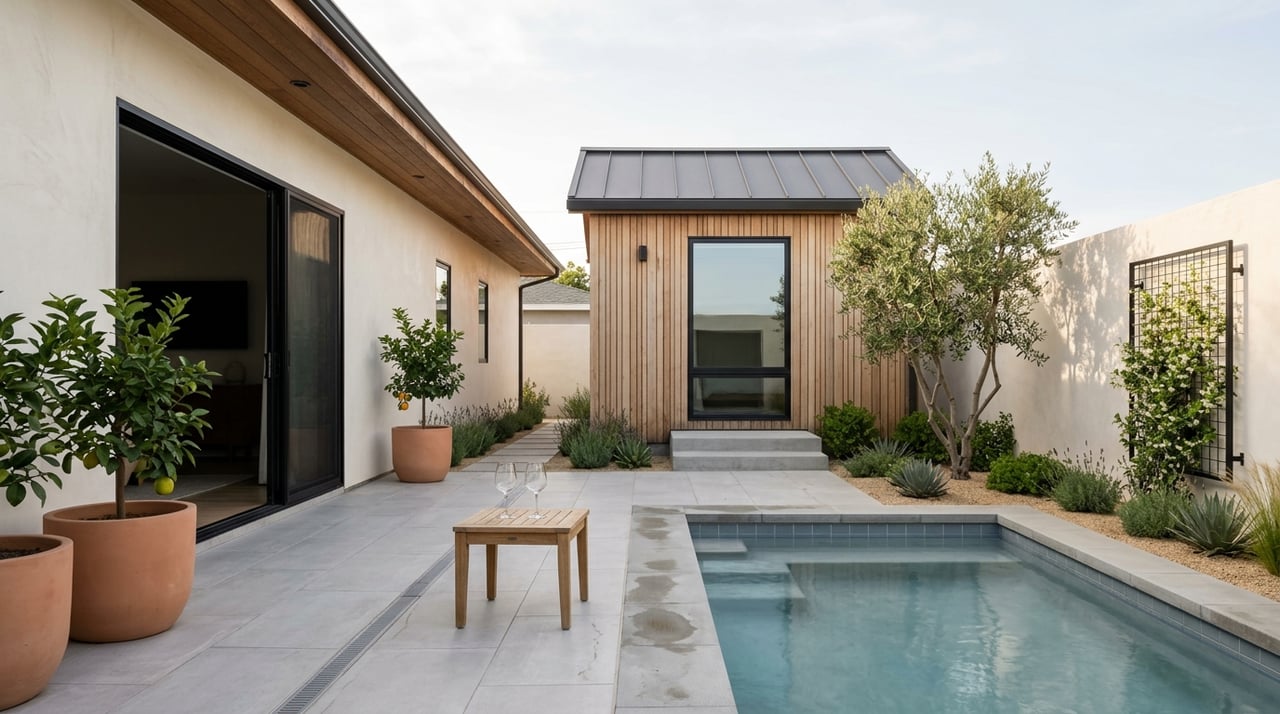
The key is understanding the difference between appeal and legal use. A shed, studio, or poolside structure may add convenience, but it does not create independent living space unless it meets ADU requirements and goes through the proper city process. That distinction matters when you are pricing a home, marketing it, or comparing one property to another.
Burbank’s preapproved ADU program
One of the most useful recent changes for homeowners is Burbank’s Preapproved Accessory Dwelling Unit Program. The city launched this program in December 2024, and the BPAP library includes city-reviewed plans. According to the city, preapproved plans are intended to reduce permit issuance timeframes to 30 days.
That does not mean every project becomes automatic. You still need parcel-specific review, and utility coordination remains part of the process. But for homeowners who want a clearer starting point, preapproved plans can make the path feel more manageable.
What the permit process involves
Burbank says ADU projects that require plan check are submitted electronically through the Building Division. Plans are screened for zoning pre-clearance during the first 48 hours of review. The application materials also direct applicants to Burbank Water and Burbank Power requirements.
That tells you something important about project planning. ADU feasibility is not just about whether there is room in the yard. It also depends on zoning, plan review, and utility coordination, which is why early research can save time and avoid expensive surprises.
How ADUs fit rental and resale goals
For many homeowners, ADU interest comes down to flexibility. Burbank does not allow short-term rentals under 30 days, so ADU value is usually tied to long-term rental income, multigenerational use, or broader resale appeal. That local rule is important because it shapes realistic expectations from the start.
If you are a buyer, an ADU-ready property may offer options for future income or extended household needs. If you are a seller, documented backyard potential can become part of the home’s story when it is presented clearly and accurately. In either case, the value comes from legal use and practical fit, not just the idea of extra square footage.
What buyers should look for
If you are shopping for a home in Burbank, backyard potential is worth evaluating early in your search. It is much easier to compare homes when you know what features matter most.
Look for these key factors:
- Zoning and any special overlays
- Lot layout and usable backyard area
- Existing garage or guest structure conversion potential
- Transit proximity for parking considerations
- Whether the property may be in the Mountain Fire Zone or R-1-H zone
- Room for setbacks and access
A backyard that looks large enough may still have limitations. On the other hand, a property with an existing garage or favorable transit location may offer more ADU potential than expected.
What sellers should understand
If you are selling a Burbank home, backyard usability can be an important part of positioning the property. Buyers often respond well to homes that offer flexibility, especially when future living arrangements or rental possibilities are part of their decision-making.
That said, accuracy matters. It is best to present ADU potential based on confirmed zoning, overlays, and city standards, not assumptions. A thoughtful marketing strategy can highlight outdoor living, lot utility, and verified possibilities without overstating what can be built.
Why local guidance matters
Backyard living and ADU potential can add real value in Burbank, but only when the details are handled carefully. City rules vary by zone, overlays can limit options, and features like transit access or existing structures can change the picture quickly.
That is why local real estate guidance matters when you are buying or selling a property with expansion potential. The right advice can help you weigh lifestyle appeal, resale value, and practical feasibility all at once. If you want help evaluating a Burbank property’s backyard potential or positioning your home for the market, connect with Valerie Gutierrez.
FAQs
What is an ADU in Burbank?
- In Burbank, an ADU is an attached or detached structure with independent living facilities for living, sleeping, eating, cooking, and sanitation on the same parcel as a single-family dwelling.
Are backyard sheds considered ADUs in Burbank?
- No. Burbank says small one-story detached accessory structures under 120 square feet may be permit-exempt if they meet certain rules, but they are not the same as legal accessory dwelling units.
How big can a Burbank ADU be?
- Burbank says a detached studio or one-bedroom ADU can be up to 850 square feet, larger ADUs can be up to 1,000 square feet, and ADUs in the Mountain Fire Zone are capped at 800 square feet.
Do Burbank ADUs need parking?
- Parking is not required if the property is within one-half mile walking distance of public transit or if the street requires a parking permit. Otherwise, one onsite parking space per ADU is generally required.
Can you use a Burbank ADU as a short-term rental?
- No. Burbank does not allow short-term rentals under 30 days, so ADUs are generally more relevant for long-term rental use, multigenerational living, or resale appeal.
What should buyers check for ADU potential in Burbank?
- Buyers should verify zoning, special overlays, lot layout, setback space, transit proximity, and whether an existing garage or permitted structure could support a conversion.